
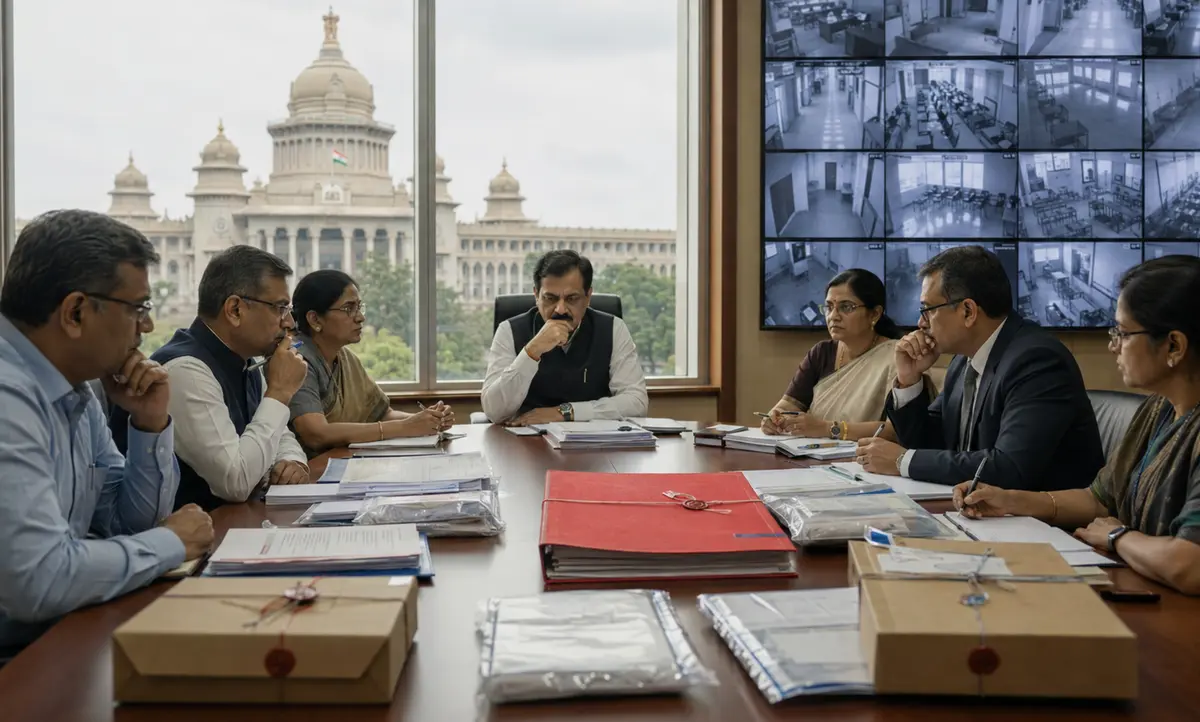
Karnataka Chief Minister D K Shivakumar has warned district Deputy Commissioners that they will be held accountable if question papers are leaked during state recruitment examinations. The order has triggered a sharp political attack from the BJP, which has accused Congress of applying different standards of accountability in Karnataka and Delhi.
The controversy comes days after Shivakumar demanded political responsibility from the Union government over the alleged NEET-UG paper leak. He had questioned why nobody at the top should accept responsibility when the future of students was affected.
Now, the Karnataka government's decision to place direct responsibility on district officials has allowed the opposition to ask a difficult question. If Congress demanded a Union minister's resignation over a national examination controversy, should the same principle apply to ministers when a paper leak occurs under a Congress government?
The state order includes important preventive measures, including CCTV surveillance, stronger protection for question papers and documentation of every stage. The dispute is therefore not about whether officials should be responsible. It is about whether administrative accountability can replace political accountability.
What Did Karnataka CM D K Shivakumar Order?
D K Shivakumar issued the warning while chairing a Bengaluru Revenue Division-level progress review meeting in Chitradurga. He told Deputy Commissioners to remain alert during upcoming state recruitment examinations and prevent any lapse in security.
Karnataka is preparing to fill more than 70,000 government posts. A paper leak during such a large recruitment drive could affect thousands of candidates, damage confidence in the selection process and force authorities to cancel or repeat examinations.
The Chief Minister directed that CCTV cameras must be installed at every examination centre. He also said question papers must receive enhanced security from the preparation stage until the examination is completed.
Every stage, including preparation, printing, transportation, distribution and conduct of the examination, must be documented. Shivakumar warned that officials concerned, particularly district Deputy Commissioners, would be held responsible if a leak occurred.
Why Is BJP Calling the Order Congress Hypocrisy?
Karnataka BJP leader R Ashoka accused Congress of protecting political leaders while passing responsibility down to bureaucrats. He compared the Karnataka order with the stand taken by Congress leaders during the NEET controversy.
Rahul Gandhi, Priyanka Gandhi and D K Shivakumar had supported protests demanding accountability from the Union government. Congress leaders argued that a serious failure affecting students required responsibility at the ministerial level.
The BJP's argument is that Congress now appears to be changing the standard. In Delhi, it demanded that accountability move upward to the political leadership. In Karnataka, it says the government has made Deputy Commissioners the first people answerable for any future leak.
Ashoka described this as a system of moral lectures for the Centre and bureaucratic blame for Karnataka. His criticism raises a legitimate political question, but it does not prove that the state government intends to protect anyone before an incident has occurred.
Is Making Deputy Commissioners Accountable Wrong?
Making Deputy Commissioners accountable is not automatically wrong. Recruitment examinations depend on a long administrative chain, and district authorities play a major role in securing centres, supervising distribution and coordinating police and education officials.
Clear responsibility can prevent confusion after a leak. When nobody knows who owns the process, officials can shift blame between examination boards, printing agencies, district administrations and centre supervisors.
The Karnataka order gives DCs a clear duty to verify security measures before the examination. It also creates pressure to document every movement of sensitive material and respond quickly to suspicious activity.
The weakness appears only if accountability stops with the DC. A paper leak may originate from a printing contractor, examination authority, technology vendor, political network or senior department. Responsibility must follow evidence rather than remain limited to the district administration.
Administrative Accountability and Political Accountability Are Different
Administrative accountability focuses on the officials who manage an examination. It asks whether security procedures were followed, who handled the papers, whether CCTV systems worked and where the chain of custody failed.
Political accountability focuses on the minister or government responsible for the department. It asks whether the leadership created a secure system, acted on earlier warnings, selected competent officials and responded honestly after a failure.
Both forms can operate together. Holding a Deputy Commissioner responsible does not prevent action against a minister. Similarly, demanding a minister's resignation does not remove the need to identify the officials or criminals who directly caused a leak.
The strongest policy would state that responsibility will be fixed at every level. Officials who fail operationally should face action. Senior officers and ministers should also answer if the investigation reveals negligence, ignored warnings or a systemic failure.
Why the NEET Controversy Matters to Karnataka's New Order
Shivakumar explicitly referred to the NEET controversy as a lesson for officials. Nationwide protests over the alleged NEET-UG 2026 paper leak created intense pressure on the Union government and ended with Education Minister Dharmendra Pradhan's resignation.
Before issuing the Karnataka order, Shivakumar had criticised Prime Minister Narendra Modi for not responding earlier. He said people responsible for leaks should not be protected and argued that someone must own responsibility when examinations fail.
That earlier statement is the foundation of BJP's hypocrisy charge. The opposition says the same test must now apply within Karnataka if a state recruitment examination is compromised.
Readers can follow the wider political debate through the latest India news page.
What Security Measures Has Karnataka Announced?
The most visible measure is compulsory CCTV coverage at examination centres. Cameras can help verify when sealed papers arrive, who enters secure rooms and whether unauthorized activity occurs before the test begins.
The government also wants enhanced protection for question papers and complete documentation of the process. This should create a traceable chain from preparation and printing to distribution and opening at the centre.
Documentation can include custody logs, sealed-package records, authorised personnel lists, vehicle movement details, timestamps and digital evidence. These records help investigators identify the exact stage where security failed.
However, CCTV alone cannot prevent sophisticated leaks. Authorities also need secure printing facilities, restricted digital access, background checks, encrypted systems, unique paper codes, surprise inspections and strict control over mobile devices.
What Must Karnataka Do Beyond Blaming DCs?
The state must define responsibility in writing instead of leaving it as a broad warning. Deputy Commissioners need a clear checklist showing what they control and what remains the responsibility of recruitment boards and government departments.
The government should create an independent response protocol for suspected leaks. The protocol must protect evidence, inform candidates quickly, prevent rumours and avoid unnecessary cancellation before facts are confirmed.
Contracts with printing presses and technology vendors must include security standards, audits and penalties. Officials should not become automatic scapegoats for failures caused by private agencies or systems controlled at the state level.
A public report should follow every confirmed incident. It should explain how the leak happened, who failed, what action was taken and how the next examination will be protected.
Does BJP's Political Hypocrisy Charge Have Merit?
The BJP's charge has political force because Congress recently demanded top-level accountability from the Union government. If Karnataka limits action only to district officials after a future leak, the accusation of double standards would become stronger.
At present, Shivakumar has issued a preventive warning before the recruitment drive. No specific new leak covered by this order has been established, and no investigation has identified who should be punished.
It is therefore too early to claim that the Karnataka government has already protected its ministers. The real test will come if an incident occurs. The public will watch whether the government investigates every level or quickly places all blame on one DC.
The BJP must also apply the same standard consistently when governments led by its own party face examination controversies. Accountability loses meaning when every party demands resignations only from its opponents.
Why Exam Paper Leaks Hurt Karnataka's Job Aspirants
A recruitment examination can represent years of preparation for a candidate. When a paper is leaked, honest applicants lose time, money and confidence in the system.
Cancelled exams create additional travel costs and disrupt work and family plans. Repeated leaks also benefit organised cheating networks and punish candidates who follow the rules.
Karnataka's plan to recruit more than 70,000 people makes security especially important. A transparent process can strengthen public administration, while a compromised process can fill departments with unsuitable candidates and trigger years of legal disputes.
Candidates can track verified recruitment information through the latest jobs and examination updates section.
Karnataka Exam Leak Accountability FAQs
What has Karnataka CM D K Shivakumar ordered?
He has warned district Deputy Commissioners that they will be held accountable for question paper leaks in state recruitment examinations. He also ordered CCTV coverage, stronger security and documentation of every stage.
Why has BJP accused Congress of hypocrisy?
BJP says Congress demanded ministerial accountability over the NEET controversy but is now placing responsibility on bureaucrats in Karnataka. Congress has not accepted that this amounts to protecting political leaders.
How many government posts is Karnataka planning to fill?
The state is undertaking a major recruitment drive covering more than 70,000 posts, making examination security a significant administrative priority.
Will Deputy Commissioners be solely responsible for every leak?
The Chief Minister specifically warned DCs, but a fair investigation must identify responsibility across the full chain, including examination boards, printers, vendors, centre officials and senior administrators.
Are CCTV cameras enough to stop question paper leaks?
No. CCTV can improve monitoring and evidence collection, but secure printing, digital protection, access controls, coded papers, audits and strict custody procedures are also required.
Should ministers also be held accountable?
Ministers should answer when evidence shows policy failure, ignored warnings, repeated negligence or an inadequate response. Operational wrongdoing must still be investigated separately.
What Will Decide Whether This Is Accountability or Scapegoating?
The Karnataka order can improve examination security if Deputy Commissioners receive authority, resources and clear procedures. It will look like scapegoating if the government punishes district officials automatically while refusing to examine failures higher in the system.
Congress has set a strong public standard by demanding political accountability at the national level. Karnataka's government must now follow that principle at home. BJP's hypocrisy accusation will ultimately be tested by the action taken after any future failure, not by political statements alone.