
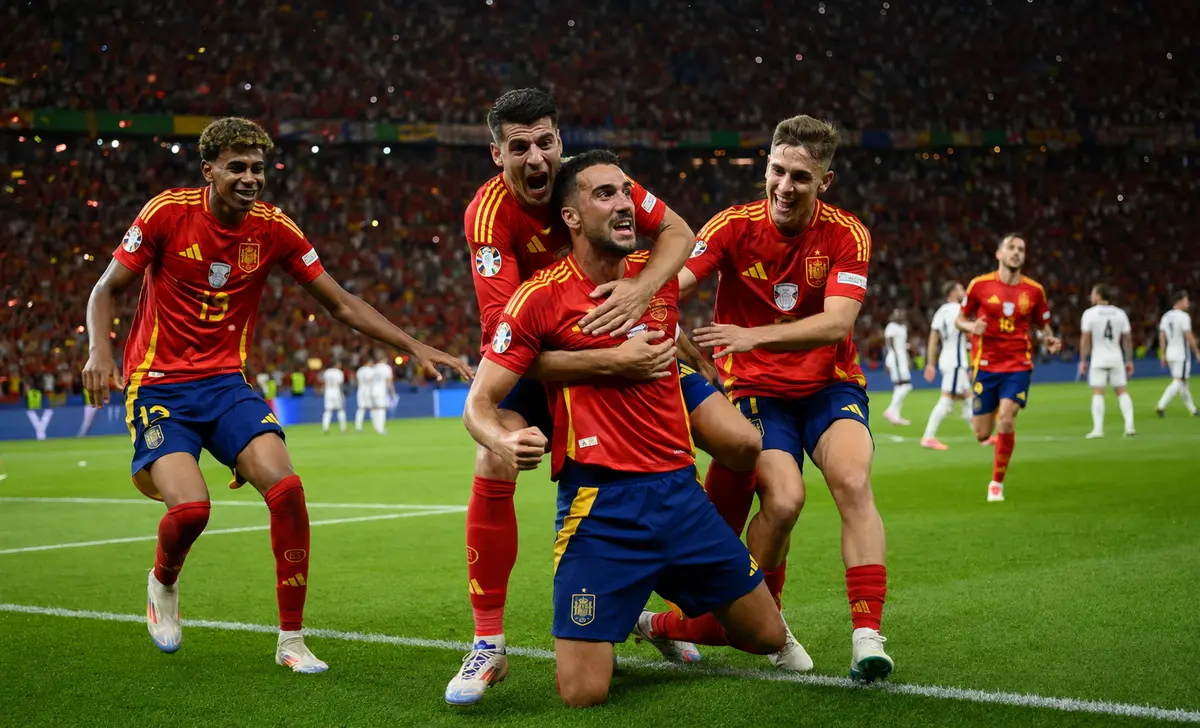
Spain's 2-1 victory over England in the UEFA EURO 2024 final was not simply decided by one late goal. It was the result of brave attacking football, intelligent movement, patient passing and a refusal to panic when England found an equaliser.
The final was played at Berlin's Olympiastadion on July 14, 2024. Spain entered the match as the tournament's most convincing team, while England arrived after surviving several difficult knockout matches. The contest remained tight during the first half, but Spain changed the rhythm after the break and gradually forced England into a defensive battle.
Nico Williams opened the scoring in the 47th minute before substitute Cole Palmer equalised for England in the 73rd minute. Just when extra time appeared possible, Mikel Oyarzabal converted Marc Cucurella's low cross in the 86th minute. Spain then survived England's final attack to become European champions for a record fourth time. Readers can follow more major sports updates from around the world on Nera News.
Spain Stayed Patient During a Difficult First Half
Spain usually controlled matches by moving the ball quickly through midfield and creating one-on-one opportunities for their wide players. England understood that danger and started the final with a disciplined defensive plan.
Phil Foden, Declan Rice and Kobbie Mainoo stayed close to Spain's central players. England tried to restrict Rodri, Dani Olmo and Fabian Ruiz from receiving the ball in comfortable positions. This reduced Spain's ability to play directly through the centre during the opening period.
Spain did not respond by forcing risky passes. They kept possession, moved England from side to side and waited for spaces to appear. Marc Cucurella and Williams combined frequently on the left, while Dani Carvajal and Lamine Yamal offered a different threat on the right.
England's defensive structure worked reasonably well during the first 45 minutes. Spain had possession and reached promising areas, but clear opportunities remained limited. The score was 0-0 at half-time, and the final still looked capable of moving in either direction.
The patience shown during this period was important. Spain did not abandon their system because England had temporarily blocked the central route. They continued stretching the pitch and trusted that England's pressing intensity would eventually become difficult to maintain.
How Spain Changed the EURO 2024 Final After Half-Time
Spain suffered a major concern when Rodri could not continue after the break. Losing such an influential midfielder in a final could have disrupted the entire team. Martin Zubimendi entered the match and performed his role calmly, allowing Spain to retain its structure.
The opening goal arrived only two minutes into the second half. Carvajal played a clever pass to release Lamine Yamal on the right. Yamal moved inside with the ball, attracting England's attention before passing across the defensive line toward Williams.
Williams arrived from the left and struck the ball first time beyond Jordan Pickford. The goal demonstrated exactly why Spain's wide attack had been so effective throughout the tournament. Yamal created the opening on one side, while Williams attacked the space from the opposite wing.
The move was fast, direct and difficult to defend. England's back line had to react to Yamal moving inside, but that reaction created room for Williams. Spain turned a small positional advantage into the first goal before England could reorganise after half-time.
Spain's Wing Play Stretched England's Defence
Spain's two young wingers created very different problems. Williams used speed and direct running on the left, while Yamal frequently moved inside from the right to create passing angles. England could not concentrate its defenders on only one side of the pitch.
When England moved across to stop Williams, Spain could quickly switch the attack toward Yamal. When England tried to reduce Yamal's influence, Cucurella and Williams found more room on the left.
This width also created opportunities for Olmo and Ruiz. England's midfielders had to cover larger distances as the match progressed. Their first-half marking system became harder to maintain once Spain increased the speed of its passing.
England Equalised but Spain Refused to Retreat
England remained dangerous because it had attacking quality on the bench. Gareth Southgate introduced Ollie Watkins and Cole Palmer as his team searched for a response.
The equaliser arrived through a quick move involving Bukayo Saka and Jude Bellingham. Saka created width on the right before the ball reached Bellingham, who laid it back toward Palmer. The substitute produced a controlled low finish from outside the penalty area.
At 1-1, Spain faced its most important psychological test of the tournament. A team can become cautious after losing a lead in a major final, particularly when the opponent suddenly has momentum.
Spain did the opposite. The players continued passing forward, attacking through the wings and moving numbers toward England's penalty area. They did not allow Palmer's goal to transform the match into a desperate defensive exercise.
This response revealed one of Spain's greatest strengths. The team trusted its football even when the situation became uncomfortable. Instead of protecting the draw and waiting for extra time, Spain continued searching for the winning goal.
Mikel Oyarzabal's Movement Created the Winning Goal
Coach Luis de la Fuente had already replaced Alvaro Morata with Mikel Oyarzabal in the 68th minute. The change gave Spain fresh movement through the centre and became decisive near the end.
In the 86th minute, Spain worked the ball toward the left. Marc Cucurella moved forward and delivered a low cross behind England's defensive line. Oyarzabal timed his run perfectly and reached the ball before the defenders could recover.
The substitute stretched forward and directed the ball past Pickford. It was a simple-looking finish created by excellent timing. Oyarzabal did not remain in a fixed position between the centre-backs. He moved at the right moment and attacked the small gap that appeared as England reacted to Cucurella.
The winning goal also showed the value of De la Fuente's substitutions. Zubimendi helped Spain retain control after Rodri's departure, while Oyarzabal provided the decisive finish. Spain did not depend only on its starting eleven. The replacement players understood the system and entered the match with clear responsibilities.
Five Reasons Spain Won the Football Final
- Width on both sides: Williams and Yamal forced England to defend the entire pitch instead of protecting only the central area.
- Midfield control: Spain continued moving the ball patiently until England's pressing began to lose its effectiveness.
- Brave substitutions: Zubimendi maintained the midfield structure, while Oyarzabal scored the winning goal.
- Calm reaction: Spain did not panic or retreat after Palmer equalised for England.
- Collective defending: Spain's attacking players worked without the ball, and the team protected its lead during England's final pressure.
Dani Olmo's Goal-Line Clearance Protected Spain's Lead
Oyarzabal's goal did not immediately settle the final. England pushed forward during the closing minutes and came close to scoring from a corner.
Declan Rice directed a header toward goal, but Unai Simon reacted to make the save. Marc Guehi then headed the rebound toward the net. Dani Olmo, who had spent much of the match creating attacks, was positioned on the goal line and headed the ball away.
That clearance represented Spain's complete team performance. The attacking midfielder recognised the danger, returned to defend and protected the winning score. Spain's victory was built on creativity, but it also required concentration and sacrifice during the final seconds.
Spain Completed a Historic EURO 2024 Campaign
The final victory completed an exceptional tournament for Spain. The team won all seven of its matches, becoming the first country to achieve that record at a European Championship finals tournament.
Spain also scored 15 goals, setting a new record for a single EURO tournament. The team defeated Croatia, Italy and Albania in the group stage before overcoming Georgia, Germany, France and England in the knockout rounds.
Those results showed that the final was not an isolated performance. Spain had already demonstrated the ability to dominate possession, counterattack quickly, recover the ball and survive difficult periods against strong opponents.
The fourth European Championship title moved Spain ahead of every other nation in the competition's history. It also introduced a new generation led by players such as Yamal and Williams, supported by experienced figures including Carvajal, Rodri and Morata.
FAQs About Spain's EURO 2024 Final Victory
Who scored for Spain against England in the final?
Nico Williams scored Spain's opening goal in the 47th minute. Mikel Oyarzabal scored the winning goal in the 86th minute after receiving a low cross from Marc Cucurella.
Who scored England's goal against Spain?
Cole Palmer scored England's equaliser in the 73rd minute. He had entered the match as a substitute only a few minutes earlier.
What was the final score between Spain and England?
Spain defeated England 2-1 in the UEFA EURO 2024 final at the Olympiastadion in Berlin.
Why was Nico Williams important in the final?
Williams scored the opening goal, repeatedly attacked England's right side and helped Cucurella defensively. His speed and movement made him one of the match's most influential players.
How many European Championship titles has Spain won?
Spain has won four European Championship titles. The country lifted the trophy in 1964, 2008, 2012 and 2024.
What Spain's EURO 2024 Final Win Teaches Modern Teams
Spain's success showed that possession becomes most effective when it has purpose. The champions did not pass the ball simply to increase their statistics. They used possession to move England, create wide spaces and find the right moment to accelerate.
The final also demonstrated the importance of trusting substitutes and maintaining tactical discipline after conceding. Spain remained committed to attacking football, responded positively to England's equaliser and protected the lead as a complete team.
For players and coaches, the practical lesson is clear. A team needs more than talented individuals to win a major final. It needs width, movement, patience, intelligent substitutions and the confidence to continue playing its own football when pressure is at its highest.