
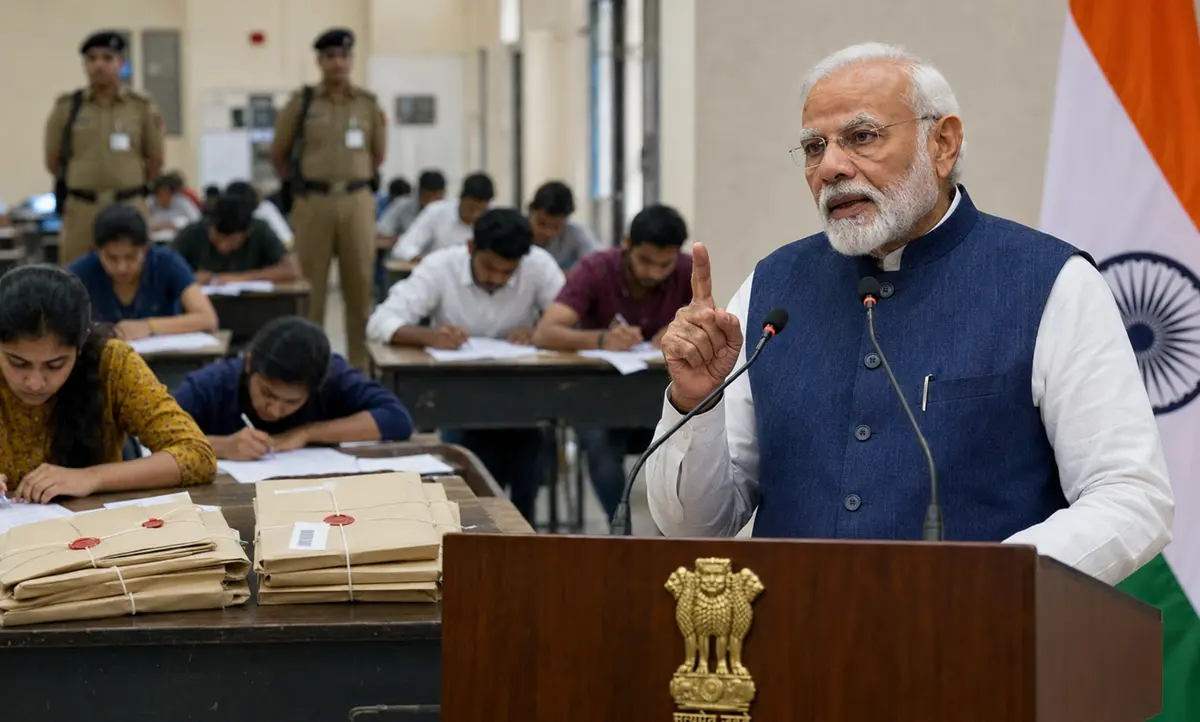
Prime Minister Narendra Modi has signalled that tougher action against examination paper leaks is coming, telling students that the government is preparing another round of measures aimed at protecting competitive examinations and punishing those who compromise them.
In a video message released on Thursday, Modi said the Union Cabinet was expected to discuss the proposed measures on Friday. According to reports, the government intends to move a new Bill in Parliament during the following week. Full provisions of the proposed legislation had not been officially released when the announcement was made.
The message comes during intense public anger over alleged examination irregularities and paper leaks, including the NEET-UG 2026 controversy. Students, parents and political groups have demanded faster investigations, clearer accountability and stronger safeguards before future examinations.
What PM Modi Said About Tougher Paper Leak Action
Modi told students that more stringent action would follow the measures already announced by the government. His message placed the welfare and future of young people at the centre of the government's response.
The Prime Minister has repeatedly said that people who damage the future of students will not be spared. Earlier, he announced plans to establish fast-track courts for paper leak cases so that trials could be completed more quickly and those found guilty could receive strict punishment without prolonged delays.
The latest video message suggests that the government now wants to strengthen the legal framework further. A Cabinet discussion is normally an important step before the government introduces a Bill in Parliament. However, the exact offences, penalties, investigation powers and examination safeguards proposed in the new measure will become clear only after the Cabinet decision and the Bill's publication.
Why the New Paper Leak Bill Matters to Students
A paper leak affects every candidate, not only the people directly involved in the crime. Students may lose months or years of preparation when an examination is cancelled, delayed or ordered again. Families can face additional coaching, travel and accommodation expenses, while admission calendars and career plans remain uncertain.
For medical entrance candidates, the consequences can be especially serious because examination dates influence counselling, college admission and the beginning of the academic year. When confidence in the examination system falls, even students who performed honestly may feel that their marks will not be evaluated fairly.
A stronger law could create clearer responsibility across examination bodies, printing centres, transport networks, digital systems, coaching operations and organised groups that allegedly trade confidential papers. Students will now watch whether the proposed Bill focuses only on punishment after a leak or also introduces systems to prevent leaks before they occur.
Fast-Track Courts and the Proposed Law Are Different Steps
The fast-track court announcement and the proposed Bill serve different purposes. Fast-track courts are intended to accelerate the hearing and disposal of cases. A new law can define offences, penalties, investigative powers and responsibilities more clearly.
Quick trials may reduce the long waiting period that often weakens public confidence in major examination cases. But courts can act effectively only when investigators collect reliable evidence, identify the full network behind a leak and complete the case without procedural failures.
The proposed legislation will therefore be judged on how it connects prevention, investigation and prosecution. Strong punishment may deter organised operators, but students also need secure question-paper systems, controlled access, digital monitoring, independent audits and transparent communication when a breach is suspected.
NEET-UG 2026 Row Keeps Pressure on the Government
The Prime Minister's message arrives while protests linked to the alleged NEET-UG 2026 leak continue to influence national politics. Student groups and Opposition leaders have questioned the role of examination authorities and demanded political accountability from the Education Ministry.
Demonstrations in New Delhi have included demands for action against those responsible, compensation for affected families and protection for students participating in protests. The controversy has also reached Parliament, where the Opposition has sought a wider discussion on examination security.
The government has argued that the issue should be treated as a national challenge rather than a partisan political dispute. Modi has described paper leaks as a serious wrongdoing against young people and called for cooperation across governments and institutions.
Readers can follow continuing developments through Nera News India coverage and the latest education and career updates.
What Details Are Still Awaited From the Government
The most important unanswered question is what the proposed Bill will contain. Reports indicate that the Cabinet will consider new measures before legislation is introduced, but the government has not yet published a complete draft in the public domain.
Students will look for details on minimum and maximum punishment, financial penalties, organised crime provisions, responsibility of service providers, protection for whistleblowers and the treatment of candidates who unknowingly receive compromised material.
Another key issue is whether the legislation will apply uniformly to national and state examinations. Recruitment tests, university entrance examinations and professional admissions can involve different authorities. Effective enforcement may require coordination among the Centre, states, police agencies, examination bodies and courts.
The government will also need to explain how the new proposal relates to existing laws and examination rules. A clear implementation plan will matter as much as the announcement because students need secure exams, timely results and confidence that genuine candidates will not be punished for the actions of organised leak networks.
What Students Should Watch Next
The first major development will be the outcome of the reported Cabinet discussion. If the proposal is approved, the text and title of the Bill should provide a clearer picture of the government's legal strategy.
The next stage will be its introduction in Parliament. Members may debate whether the proposed penalties are sufficient, whether examination agencies face enough accountability and whether affected students should receive defined remedies when a test is cancelled.
Students should rely on official announcements from the government, Parliament, examination authorities and courts. Messages claiming that a new law has already taken effect should be treated carefully until the Bill completes the required legislative process and receives formal approval.
PM Modi Paper Leak Action FAQs
Has the new paper leak law already come into force?
No. Reports say the Cabinet is expected to discuss new measures before a Bill is introduced in Parliament. The proposal must complete the required legal process before it can take effect.
What did PM Modi announce earlier?
Modi earlier announced fast-track courts for paper leak cases to support quicker trials and strict punishment for those found guilty.
Will the proposed law cover NEET-UG 2026?
The final scope will depend on the published Bill and its legal provisions. The announcement comes amid the NEET-UG 2026 controversy, but specific coverage should not be assumed before the text is released.
When will Parliament discuss the Bill?
Reports indicate that the government intends to introduce the Bill during the following week after Cabinet consideration. The confirmed schedule will depend on official parliamentary business.
Why the Next Government Announcement Will Be Important
Modi's promise of tougher action has raised expectations among students who want examination reform to produce visible results. The credibility of the next step will depend on the detail of the Bill, the speed of investigations and the practical security improvements introduced before future tests.
For students, the central demand remains simple. Examinations must be fair, secure and conducted on time. Those responsible for leaks must face justice, while honest candidates should not repeatedly pay the price through cancellations, delays and uncertainty.