
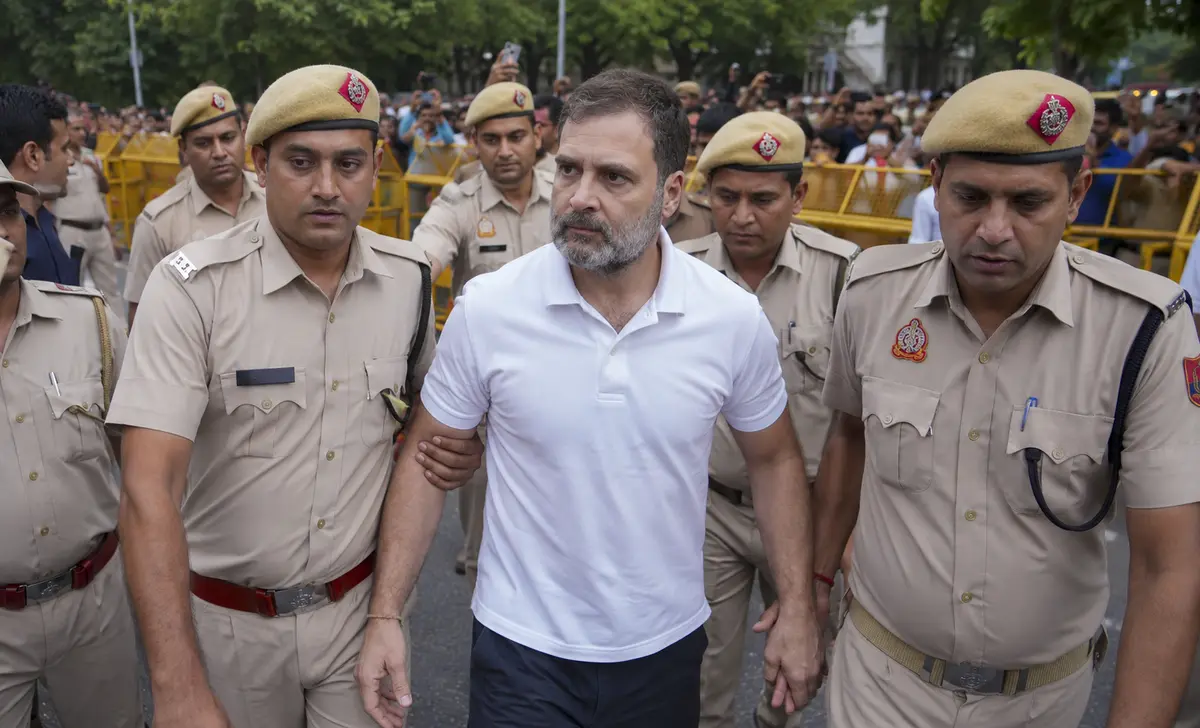
Rahul Gandhi was detained by Delhi Police on Tuesday evening after a Congress-led protest near Prime Minister Narendra Modi's residence in New Delhi. Priyanka Gandhi Vadra and several other Opposition leaders were also removed from the protest site as the demonstration over alleged police action against students entered a tense phase.
The protest followed clashes during a youth-led march in the national capital a day earlier. Congress leaders said they wanted the Prime Minister and the Union government to answer questions about the treatment of students protesting over the alleged NEET-UG 2026 paper leak and wider concerns about the examination system.
Why Rahul Gandhi Was Detained in Delhi
Rahul Gandhi, Congress president Mallikarjun Kharge, Priyanka Gandhi and other party leaders marched towards the Prime Minister's official residence at Lok Kalyan Marg. They later began a sit-in near the area, demanding accountability for the reported injuries suffered by protesters during Monday's demonstration.
The protest continued for several hours under heavy security. Police eventually moved in at around 6.40 pm and detained or removed several leaders. The action followed discussions between government representatives and the protesting leaders that did not produce a complete agreement.
Rahul Gandhi said the march was intended to seek answers over what he described as brutality against young students. Congress leaders also accused the authorities of refusing to clearly disclose where some detainees were being taken.
NEET Row at the Centre of the Protest
The confrontation is linked to anger over an alleged NEET-UG paper leak and demands for stronger action to protect students. Youth protesters have accused the government of failing to prevent examination irregularities and have sought accountability from the education ministry.
The demonstrations gained further attention after Monday's march towards Parliament led to clashes between protesters and police. Protest organisers alleged that force was used against participants, including students and women. Reports said several people were injured, while authorities maintained heavy security around sensitive government areas.
Before Tuesday's protest, Rahul Gandhi and Priyanka Gandhi visited injured students receiving treatment at Ram Manohar Lohia Hospital. Their visit increased political pressure on the Centre and turned the student agitation into a larger Opposition campaign. Readers can follow further developments through the latest India news updates.
Talks With Jitendra Singh End Without Agreement
Union Minister Jitendra Singh met Rahul Gandhi during the sit-in and held discussions aimed at ending the protest. The government indicated that it was prepared to discuss matters connected to NEET and the student movement in Parliament.
However, the talks did not result in the protest being withdrawn. Congress continued to demand stronger action, including accountability at the highest level and action concerning Union Education Minister Dharmendra Pradhan. Jitendra Singh later accused Rahul Gandhi of changing the terms after an assurance of a parliamentary discussion had been communicated.
Congress maintained that a debate alone would not address the seriousness of the allegations or the reported police action. The disagreement left both sides publicly blaming each other for the failure to reach a settlement.
Opposition Leaders Join Rahul Gandhi Protest
The protest expanded beyond Congress as leaders from other Opposition parties arrived in support. Samajwadi Party chief Akhilesh Yadav and NCP (SP) leader Supriya Sule were among those associated with the demonstration, while several INDIA bloc MPs presented a united front.
The presence of multiple Opposition leaders turned the event into a major political confrontation during the Monsoon Session of Parliament. The Opposition argued that student concerns and alleged examination failures deserved an immediate debate. The government said it was willing to discuss the issue through parliamentary procedures.
The Aam Aadmi Party, however, criticised the Congress protest and questioned why Rahul Gandhi was able to demonstrate near the Prime Minister's residence while the youth-led movement had struggled to secure talks. That criticism added another layer to the Opposition politics surrounding the agitation.
What Rahul Gandhi's Detention Means
The detention is likely to intensify the dispute over NEET, student safety and the right to protest. Congress is expected to argue that the government is avoiding accountability, while the Centre may focus on security restrictions and established rules for demonstrations near high-security locations.
For students and families, the central issue remains confidence in the examination process. Allegations of leaked papers can affect millions of candidates who spend years preparing for competitive tests. The growing protests show that the controversy is no longer limited to an administrative investigation and has become a national political issue.
The immediate question is whether the government and Opposition will agree on a structured discussion in Parliament and whether that debate will lead to concrete measures. Attention will also remain on the condition of injured protesters, the status of those detained and any official investigation into the clashes.
Rahul Gandhi Detention FAQs
Why was Rahul Gandhi detained?
Rahul Gandhi was detained after taking part in a prolonged protest near the Prime Minister's residence in Delhi. The demonstration demanded accountability over alleged police action against students protesting examination irregularities.
Were other leaders detained?
Priyanka Gandhi Vadra and several other Opposition leaders were also removed or detained when police ended the sit-in. Akhilesh Yadav and other INDIA bloc representatives had joined the protest.
What was the main demand?
The leaders demanded answers over alleged police violence, a full discussion on the NEET controversy and stronger accountability from the government, including action concerning the education ministry.
What Happens Next After Rahul Gandhi's Detention
Rahul Gandhi's detention has raised the political stakes around the student movement. The next major development may come in Parliament, where the Opposition is expected to press for a debate and specific government action. Until an agreement is reached, protests and political exchanges over the NEET controversy are likely to continue.