
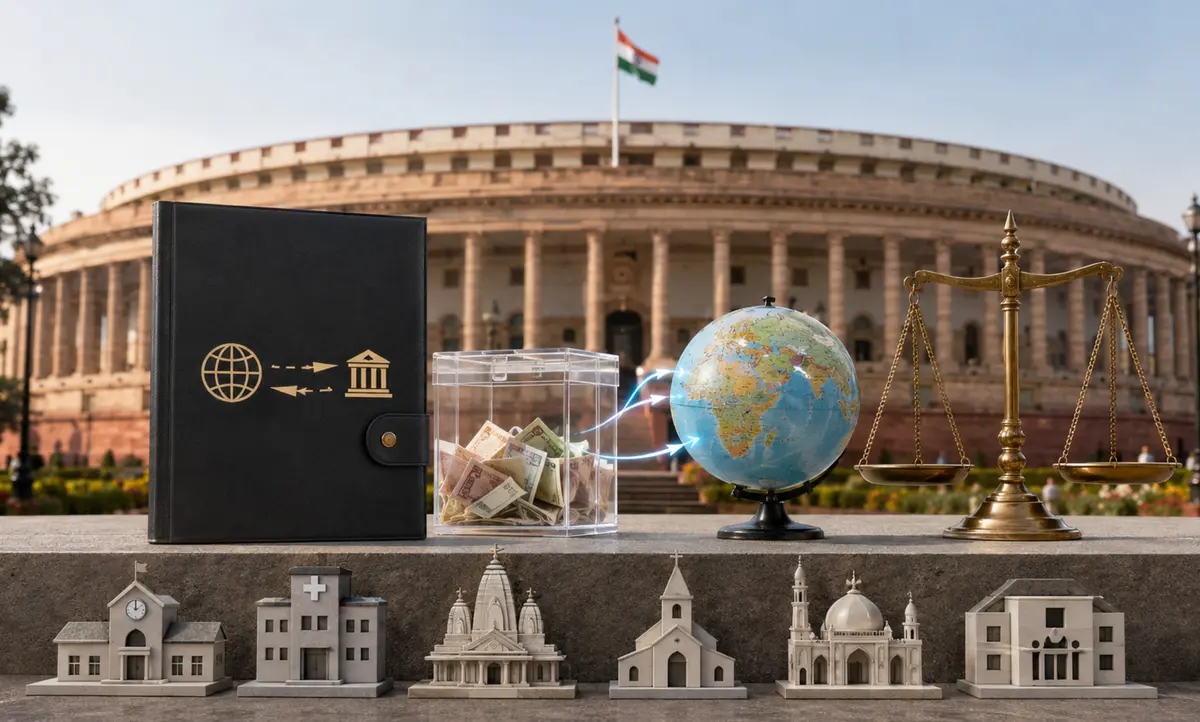
India's FCRA law regulates foreign money received by NGOs, trusts, religious organisations, companies and other associations. The proposed FCRA Amendment Bill, 2026 has brought the law back into national debate because it could give a government-appointed authority control over assets created from foreign contributions when an organisation loses its registration.
The Bill has also raised questions about religious freedom and conversion-related activity. New rules identify several religious purposes that may receive foreign funding, while excluding proselytisation from permitted religious activity.
Claims that the United States is angry with India need careful examination. Some US-based religious freedom and civil society groups have strongly criticised the proposal. However, public criticism by American organisations should not automatically be described as an official position of the entire US government.
What Is the FCRA Law in India?
FCRA stands for the Foreign Contribution Regulation Act. It controls how individuals, associations, NGOs, trusts and companies in India receive and use contributions from sources located outside the country.
A foreign contribution can include money, securities and certain articles received from a foreign source. Income generated from an original foreign contribution may also remain subject to the law.
The Ministry of Home Affairs administers FCRA. An eligible organisation usually needs FCRA registration or specific prior permission before accepting foreign funds. It must receive, use and report the money through the prescribed system.
FCRA does not impose a complete ban on foreign donations. Registered organisations can continue receiving money for approved activities, provided they follow account, disclosure and utilisation rules.
Why Was the FCRA Law Created?
India introduced the first FCRA law in 1976. The main aim was to prevent foreign money from improperly influencing politics, public institutions, elections, media and activities affecting national interests.
The 2010 law replaced the earlier framework and created stricter registration, renewal, reporting, suspension and cancellation rules. Later amendments increased government oversight and changed how organisations receive and transfer foreign contributions.
The government argues that foreign donations must remain transparent because money from another country can influence public campaigns, institutions and social activity. Critics agree that financial transparency is necessary but argue that broad executive powers can be used against lawful civil society work.
Readers can track the political debate through the latest India news section.
What Does the FCRA Amendment Bill 2026 Propose?
The most debated proposal concerns assets created from foreign contributions. The Bill provides for a Designated Authority that can manage such property after an organisation's FCRA certificate ceases to operate.
This may happen when registration is cancelled, surrendered or not renewed. The assets can provisionally vest in the authority while the organisation seeks restoration of its certificate.
If registration is restored within the prescribed period, the assets are expected to be returned. If restoration does not occur, the vesting can become permanent and the authority may manage or dispose of the property according to law.
The Bill also introduces revision and judicial appeal mechanisms against decisions of the Designated Authority. It reduces the maximum imprisonment for certain violations from five years to one year, although other regulatory consequences can remain significant.
Can the Government Take Control of Foreign-Funded Assets?
Under the proposed Bill, the government would not automatically take every asset owned by every NGO receiving foreign donations. The provision is linked to property created from foreign contributions and to the cessation of the organisation's FCRA registration.
The Designated Authority would take control according to the process provided by the law. Initial vesting can be provisional, and restoration may occur if the FCRA certificate returns within the permitted period.
Critics argue that an organisation may lose control of buildings, schools, hospitals or other property even when its registration expires because of a renewal dispute rather than proven criminal misuse. They want stronger safeguards, clear timelines and independent review before control changes hands.
The government says the system protects assets created through foreign money and prevents their misuse after the organisation loses legal permission to receive such contributions.
What Happens to Churches, Temples, Mosques and Places of Worship?
The Bill contains a safeguard for property that functions as a place of worship. The Designated Authority must preserve its religious character while managing or disposing of the asset.
This means a church, temple, mosque, monastery, gurdwara or another place of worship should not lose its religious identity simply because the authority temporarily controls the property.
Questions remain about how this protection will operate in practice. Many religious properties combine worship, education, residential, medical and charitable functions within one campus. Clear rules may be needed to identify which parts receive special protection.
The asset provision applies to all communities in principle. Its actual fairness will depend on consistent enforcement, transparent orders and access to effective appeal.
Will the New FCRA Rules Affect Religious Conversions?
The 2026 framework can affect foreign funding used for conversion-oriented activity. The amended rules identify permitted religious purposes but exclude proselytisation from that category.
Proselytisation generally refers to organised efforts to persuade another person to adopt a religion. Under the new approach, an organisation should not treat foreign-funded proselytisation as an approved religious purpose for FCRA registration or use.
This does not create a general national ban on every personal change of religion. FCRA regulates foreign contributions. Questions about individual conversion, coercion, fraud or state anti-conversion laws involve separate constitutional and legal issues.
The practical effect is financial. Organisations whose programmes are considered conversion-oriented may face rejection, non-renewal, cancellation or restrictions on using foreign donations for those activities.
Does FCRA Ban All Foreign Funding for Religious Work?
No. The government says faith-based welfare and religious activity can remain eligible for foreign funding when organisations meet FCRA conditions.
Permitted work may include religious education, maintenance of places of worship, training of religious personnel and charitable activity. Hospitals, schools, food programmes and relief projects run by faith-based organisations are not automatically prohibited because the organisation has a religious identity.
The dividing line is the declared purpose and actual use of funds. A religious charity may receive foreign support for an approved hospital programme but cannot automatically use the same money for an activity classified as proselytisation.
Organisations will need accurate applications, separate accounts, clear programme records and evidence showing how each foreign contribution was used.
Will FCRA Stop Forced Religious Conversions?
FCRA can restrict foreign money linked to alleged conversion activity, but it cannot by itself eliminate forced conversion. It is primarily a financial regulation law.
Cases involving force, fraud, threats or unlawful inducement require investigation under criminal law and applicable state legislation. Authorities must establish facts and follow due process rather than assume wrongdoing only because an organisation receives foreign funds.
The new restrictions may make it harder to finance organised conversion campaigns from abroad. Their effectiveness will depend on financial tracking, evidence and fair enforcement.
There is also a risk that vague allegations could affect legitimate welfare work. Clear definitions and independent review are essential so that genuine charitable activity is not treated as conversion without evidence.
Is the United States Upset About India's FCRA Bill?
It is inaccurate to treat every American criticism as proof that the US government as a whole is upset. No clear official statement from the US State Department on the specific 2026 Bill was identified in the public material reviewed for this explainer.
US-based advocacy organisations have raised strong objections. The Religious Freedom Institute in Washington has urged India's Parliament to oppose the Bill, arguing that it threatens religious organisations receiving foreign donations.
International civil society and human rights groups have also criticised the wider FCRA framework. They argue that tighter funding rules can weaken freedom of association and reduce the ability of NGOs to operate independently.
These objections create pressure in Washington and can influence discussions involving lawmakers, religious freedom bodies and donors. They do not amount to proof of a formal diplomatic confrontation between India and the United States.
Follow related international developments through the latest world news page.
Why Are US-Based Religious Groups Concerned?
Many American churches, foundations and charities support Indian partners involved in education, healthcare, humanitarian relief and religious programmes. Stricter rules may reduce their ability to fund those organisations.
The asset-vesting provision creates a separate concern. Foreign donors may hesitate to fund buildings or long-term projects if an Indian partner could lose control of the property after a registration dispute.
Religious freedom groups also object to the exclusion of proselytisation. They view sharing faith as part of religious expression, while the Indian government treats foreign-financed conversion activity as an area requiring restriction.
This difference reflects a deeper disagreement between unrestricted religious advocacy and India's claim that foreign funds should not alter its social or demographic character through conversion-oriented campaigns.
Why Does the Indian Government Defend the FCRA Changes?
The government presents FCRA as a transparency and sovereignty law. It says legitimate charities can receive foreign money while organisations must account for how the funds are collected and spent.
Supporters argue that India has the right to control overseas money used within its borders. They say no foreign donor should receive unrestricted power to influence politics, public campaigns, religious conversion or sensitive social issues.
The government also says the asset mechanism safeguards property purchased through foreign contributions after the registered organisation ceases to qualify under FCRA.
Its case will be stronger if orders are transparent, appeals are timely and the same standards apply across religions and political viewpoints.
What Are the Main Criticisms of the FCRA Bill?
Opposition parties, minority organisations and civil society groups fear excessive executive power. They argue that losing an FCRA certificate should not automatically lead to permanent loss of property without a strong judicial process.
Critics also say registration may lapse because of delays, documentation disputes or changing interpretations. They want the law to distinguish between serious financial wrongdoing and correctable compliance failures.
Another concern is uncertainty. Broad terms can make NGOs cautious about lawful advocacy, research and community work because they fear suspension or cancellation.
The government points to the right of revision and judicial appeal as protection. The real test will be whether an organisation can obtain meaningful review before irreversible action occurs.
How Will FCRA Affect NGOs and Foreign Donors?
NGOs will face greater pressure to maintain registration, file accurate returns and match every foreign-funded programme with an approved purpose. Boards must understand that loss of registration may affect property as well as future donations.
Foreign donors may demand stronger legal checks before financing buildings, schools, hospitals and other permanent assets. Agreements may need to explain what happens if the recipient's certificate is suspended, cancelled or not renewed.
Faith-based organisations should separate charitable service from conversion-oriented activity and maintain detailed records. They must ensure that public communication, programme documents and expenditure reports remain consistent.
People looking for opportunities in registered organisations can follow the latest jobs updates, while organisations should seek qualified legal and accounting advice for compliance decisions.
FCRA Law FAQs
What is the full form of FCRA?
FCRA stands for the Foreign Contribution Regulation Act. It regulates foreign contributions received and used by eligible individuals and organisations in India.
Does every NGO need FCRA registration?
An organisation that wants to receive foreign contributions generally needs FCRA registration or prior permission, subject to the conditions and exemptions provided by law.
Can the government seize an NGO's property?
The 2026 Bill proposes vesting certain assets created from foreign contributions in a Designated Authority when an FCRA certificate ceases. Provisional control may be reversed if registration is restored.
Does FCRA ban Christianity or any religion?
No. The law applies across religions. Faith-based welfare and specified religious activities can remain eligible, but foreign-funded proselytisation is excluded from permitted religious purposes under the 2026 rules.
Will FCRA stop all religious conversions?
No. FCRA regulates foreign money, not every personal decision to change religion. It can restrict foreign funding used for conversion-oriented activity.
Has the US government officially opposed the Bill?
US-based advocacy groups have opposed it, but that should not be presented as a confirmed position of the entire US government without a specific official statement.
Can an NGO challenge an asset-control order?
The proposed framework includes revision and judicial appeal to a district judge. The effectiveness of this safeguard will depend on timelines, procedure and whether action is paused during appeal.
What the FCRA Bill Means in Simple Terms
The FCRA law allows India to monitor foreign money entering NGOs, charities and religious organisations. The 2026 Bill goes further by creating a mechanism to control foreign-funded assets when registration ends.
It can reduce foreign financing for proselytisation, but it does not ban all religious charity or every conversion. US-based groups are worried about religious freedom and civil society, yet claims of an official US confrontation should be treated carefully.
The central debate is not whether foreign money should be transparent. It is whether the government receives too much control and whether organisations have enough protection against unfair cancellation, asset loss and selective enforcement.